Excerpts from “Being & Caring”, Part One Chapter Two

BEING AND CARING by Victor Daniels and Laurence J. Horowitz

Highlights from the book chosen by The Happy President.

CHAPTER TWO: ENJOYING LIFE: FROM JUDGING TO APPRECIATION

We all have the capacity to enjoy life. But instead we may act out old habits that darken our days and sabotage our hopes.

We can find ways to enjoy what we do. “There are over eight hundred ‘happy texts’ in the Bible. If God said that many times to be glad and rejoice, he must surely have meant it.” Learning to celebrate our existence in work, play, and relationship is both a religious and a spiritual charge.

Unless I’m living in a way that pleases me, my actions and projects are unlikely to nourish others. If you enjoy your own existence, your actions and undertakings are more likely to help others enrich their lives, too. What else have we got to do that’s more important than learning how to be good to ourselves – and to those around us? How fully we enjoy our lives is dependent on our self-esteem: how we feel about ourselves and perceive our value to others. High self-esteem, an attitude that includes self-respect and good feelings about ourselves, makes it easy to enjoy life. Low self-esteem, an attitude that includes feelings that we’re somehow wrong, bad, or inadequate, makes it harder.

A tragic irony is that if my own self-esteem is low, I may depreciate others so I can feel good by comparison: “At least I’m not as bad as you.” In doing that, I challenge their self-esteem.

Thus, self-esteem is a learned process that emerges from our social interactions. To a significant degree, it’s an estimate of how I perceive the people in my environment valuing me.

Listen to what you say to others. Does your comment seem to make the other person feel better or worse about himself or herself?

THE NATURE OF JUDGMENT

We all know the feeling many call “bitterness in our hearts.” When I feel this way, I tend to pass harsh judgment on whomever or whatever comes my way. As I pass judgment, I separate myself from others. These are depreciative judgments.

Evaluation, Preference, and Judgment

Our own judgments about what we do and don’t value provide us needed life-orientation and guidance. Constructive criticism of our ideas and undertakings gives us feedback about what’s useful and what isn’t. But we don’t have to transform the need for constructive appraisal into habitual rejection through judgment that can pervade our lives, interfere with our appreciation of ourselves, and demean the beauty in our world.

To clarify that distinction, when I have to make decision or choose among alternative, I call it evaluation. Evaluation is considering the effects of something: Is it helpful or harmful?

Liking or disliking, by contrast, is primarily a feeling process. I enjoy this more than that. When I pay attention to what I actually prefer now, I’m likely to respond more openly instead of staying locked into old habits.

Instead of saying, “I don’t like Brian,” I say, “Brian is a jerk” (he is, you know). Instead of stating my own feelings, I pretend, even to myself, that I’m responding to “the way things are.”

I use the term projective judgments for these feelings disguised as judgments. I assign my own feelings to some aspect of the person, thing, or event I’m judging instead of recognizing that they come from me. I define you in terms of what’s happening in me.

Accusations, condemnations, and rejection contribute to lo self-esteem in others and, when directed inward, maintain it in ourselves. When I let go of judgment in this sense, I open myself to a broader canvas of experience.

Habitual judging makes life brittle. Few things steal more vitality, or cast a chiller, darker mood, than the habit o criticizing and condemning.

We can think about the counsel Jesus offered: “Pass no judgement, and you will not be judged; do not condemn, and you will not be condemned; acquit, and you will be acquitted; give and gifts will be given you…for whatever measure you deal out to others will be dealt to you in return.” (Luke 6:37-38, New English Bible)

Roman Emperor Marcus Aurelius commented, “Men exist for the sake of one another. Teach them or bear with them”. When I feel an impulse to criticize people, I might first ask myself, “Am I willing to take the time to show them a better way to do it non-judgmentally so they’ll be willing to hear? Do I know a better way – really?”

Discovering What’s Beneath Our Judgments

When we don’t feel impelled ot respond to hostility with hostility, we’re apt to make better contact with people and resolve issues more effectively. Discriminate between evaluation and depreciation. I’m more likely to hear you when you tell me your feelings, or when you describe how you react to what I do, than when your words or voice imply that you’re better and I’m worse.

It is important that we acknowledge our humanity. I don’t have to pretend to be nonjudgemental about things I really do judge. As you feel the bitterness that lingers on in you, be gentle with yourself. If you forgive no one else, at least forgive yourself.

DISCOUNTING OURSELVES

Many people (not just those who chronically feel bad about themselves) disparage themselves, as much as – or even more than – they put down others.

How many times a day do you feel inferior? But ask yourself, inferior compared to what? Compared to what you might realistically expect to be and do, given your background and the breaks you’ve had? Of course not. That way you’d come out right where you are.

You can improve your skill at doing almost anything, once you get rid of your image of yourself as “no good at it.”

Here is one of the most important statements in this book: At this point in your life, at this moment in time, however you are, it’s all right for you to be that way. To feel what you feel, to think what you think, to do what you do. What is, is. What you are, you are. Recognizing that can make it easier to begin moving today in directions that will help you feel better about your life tomorrow.

“Shoulds”

Every depreciative judgment about myself has a “should” at its center. I “should” be a certain way, and if I’m not, I’m defective.

“Should”, as it’s widely used, carries a quality of absoluteness. The things I “should” are are right, and the things I “shouldn’t” do are wrong. And that’s that.

When my mind is filled with what I “should” have done, ordinarily I don’t find out as much about what happened as a result of what I did.

WORKING WITH JUDGMENTS

Monitoring depreciative judgments can decrease their frequency and intensity. The most reliable way to monitor your judgments is to count them.

SAYING “YES” TO OURSELVES

There are several alternatives to depreciative judgment. One is positive judgment. Another alternative is to appreciate something for what it is, without judging it as either good or bad.

The Theory of Positive Intent

Appreciating what’s going on involves two steps. 1) Recognizing what it is in our behavior that drives away the very response we want from others or that defeats us in other ways. 2) Recognizing that we don’t defeat ourselves because we’re bad, sick, stupid, or crazy, but when we don’t recognize and honor our own positive intent, nor that of others.

The theory of positive intent helps us take an apparently negative, destructive behavior and use it as a starting point for growth.

The Perfection in What Is

Perfection has two very different meanings. One is the gradual change from being “imperfect” to being “perfect.” The other is the perfection of each thing that exists, just as it is right now.

Here and now, I’m a perfect me, and you’re a perfect you. No one in the world can be as perfect as You as You are.

None of this means that we need to tolerate troublesome conditions in our lives that we can change. Instead, the task is to get in touch with exactly how things are not okay, and set out to remedy that.

Saint Theresa of Avila said it beautifully: “Lord, grant me the serenity to accept the things I cannot change, the courage to change the things I can, and the wisdom to know the difference.”

Since I have some choice about how I feel, I can feel hostile, angry, and bitter as I work to change harmful conditions, or I can feel full, alive, and in contact with myself and my world.

Art Hoppe, my favorite newspaper columnist, wrote one day, “If we all celebrated life, who could oppress or kill or hate his fellow man?”
Money and Value

What is money? Where does it come from? How do we use it? How does it make us feel?

The current climate of the world is that of massive job layoffs, businesses closing to keep people healthy, and humans scared of getting a paycheck to afford to live each month. When we’ve operated on this “you have to work for money” idea, and when there is no work to be done, what do we do? Of course there are things that can happen that improve humans lives but don’t “earn” money. But the money system, as it stands, is broken. We won’t be having as many jobs in the future (yay!) because we have a new system that makes life easy for everyone. 

We’ve got to adapt the system. We have to look at finance and see what things really cost, and at what cost they are to Earth and humanity. We have to stop pollutive industries and we need to use technology to improve quality of life for each and every one of us. We are operating on a hundred year old system and it needs to change.

Money came about as a neutral way to exchange goods and services. It makes sense. I have cows that make milk, you have wheat that can be made into bread. How do we figure out what is a fair trade? Well, whatever the two parties agree upon. But milk goes bad after some time, and wheat can get moldy. What if I want to give some of my milk now but don’t want any wheat? Now we create a neutral, non-perishable form of transfer in the form of metal coins, or shells, or any neutral item. Money was created because it doesn’t “go bad” like milk. It can be taken and used for anything. I like it. It makes sense.

Traders would bring goods to market and then sell them to buyers who liked getting things they could not provide for themselves. When you have foreign travelers, you will have some foreign forms of currency. Some people use gold coins, some people use silver coins, some people use shells from their local beach. With these different forms of currency, we now need to create an exchange rate and thus have someone that sits at a table – in Italian table is banco, where the word for bank comes from – and makes sure you can exchange one form of currency for another at the same value. These table bankers now became middle men – only dealing with money and not the exchange of goods.

When you accumulate a bunch of gold coins, what do you do with them? Well, you could store them in your house but you don’t have much security and people could come and steal it pretty easily. So now we have fortified buildings that will hold our gold for us, keep it safe, and let us access it whenever we want. We also realized that for larger transactions it is a lot easier to have a piece of paper with a value on it rather than dragging a roomful of gold across town. So we have representative money – paper money that says it is worth something backed up by the bank holding your gold. It says that whomever has this note has the right to access so much gold in that particular bank. Cool.

What do banks do with all that gold sitting around? They figured out that you don’t come back to take much out very often, so would you notice if it weren’t all there? Well, they take the gold that you put in and loan it to someone else who wants to do something but can’t afford it on their own. The bank loans your money to other people. You don’t get a say to who is getting your money now that it is in the bank’s hands. The bank makes money off of interest from the loans. But why? What service are they really providing except for using someone else’s money without them knowing hoping that they don’t come to claim their gold at once?

Cows. That’s where the concept of interest comes from. Let’s say I have a heard of cattle but want to get on a boat and search for exotic spices. You have a boat but are sick of sailing and wouldn’t mind looking after the cows for the year or so it takes you to come back. What happens to a heard of cows after a year? They procreate, making little cow babies. So your one hundred cows are now hundred and seven cows. You can still keep the hundred cows you originally left, but it’s easy to let the seven new cows go to the guy that watched them for you. Makes sense.

Banks charging interest on money loans make no sense. Cows growing makes sense. Money to make money is immoral. Money to create value and add wealth is moral.

How these big corporations are making money off of humanity is by selling information that we don’t even realize they have on us. Anyone with a new car, one with cameras and GPS and all the fun stuff – those car companies track you and sell your information to the highest bidder. It knows where you go, what you listen to, and has videos of the area you live. Alexa hears everything you say. Siri listens to you. Targeted ads are everywhere, but I see a world where we don’t need more cheap products, we need more life-improving products that empower the individual.

What is the shift? It will be easy, actually. We look at corporate finance and take all the weeds out. We look at efficient energy systems using the modern technology that these corporations have access to and we shift from a weaponry making system to a livingry making system. It’s nice to see business with factory infrastructures switching production from cars or clothes to ventilators and scrubs for the health and safety of humanity. We can change.

The Earth wants to be played on. She wants humans to be happy, outside, laughing and jumping and playing on her with your friends, family, loved ones. She doesn’t want you stuck in a cubicle staring at emails all day. She doesn’t need you to make another million dollars on Wall Street, she needs you to laugh on the beach and jump in the ocean. 

We do not need a bigger economy. We do not need more jobs. We have the technology, the knowhow, and the strength to create new systems where jobs are optional, you pursue what you want, and there is a basic level of care for each and every human on the planet. Earth does not charge rent for its inhabitants.

Transparent Finances for All. Removal of Corporate Personhood and the freeing up of all the money they weaseled out of paying.

What are taxes, and where do they go? Why do corporations not have to pay what they owe yet individuals do?

We also have to blend local and global economies. I’m for a one Earth currency, so no one is making money betting on exchange rates. Food becomes more local – grown in the Earth in your own backyard or a nearby public plot. Let’s disperse our population and get connected to the Land again. There are inexpensive high quality housing options that have been available and we are not using them. With technology it will be easy for us to have the luxuries we are used to but with an energy efficient, Earth-friendly way.

Money is formed out of a transaction. It’s when two or more parties need to agree on an exchange – putting a value on what something is worth. Money is not actually value. Or even real energy. It is a representation of energy and that is it. It is what we agree it to be. It came about naturally but then got manipulated by banks.

Profit seems to be a nasty word to me. Value, wealth, abundance are nice words. We can still use money as a form of exchange, but the cost of everyday items will be reduced considerably. It will be easier to live and breathe and play. We might need to build more theme parks.

Health and Happiness

The world is currently shutting down its usual activities due to the fear of COVID-19, commonly called the coronavirus. Two of my activities have been cancelled for the next two weeks because anyone with a cough or sniffle could give anyone else a deadly disease. Theme Parks, some of the most internationally visited places in the world, are shutting down for obvious reasons. The grocery store was busier than usual today, though. Toilet paper was sold out, pasta was almost all gone. People are really less concerned about carbs and more concerned with wiping their butt.

While I want everyone to be healthy, I would like to think that COVID-19 is just a way for Earth’s inhabitants to have time to stay at home and chill for awhile. Stop the hustle and grind to get a paycheck and instead slow down and check into the moment. Catch up on that latest streaming show. Call people you haven’t talked to in awhile. Learn a new skill even if you may never show it off in person. Live as if the the world is changing. Laugh with me, just not on me. 

Spend time at home cleaning through your old shit. Read up on the KonMari Method. Keep only what sparks joy in you. Eat consciously. Plant a garden and see what grows by the time this whole thing ends. How you take care of your home speaks volumes about you. Keep yourself clean and stop using so much toilet paper.

Don’t let this silly virus that originally came from a chicken make us become zombies to one another. Stay healthy, wash your hands, and trust in the power of the human body. It has been scientifically proven to be able to heal itself.

Stay Happy and Healthy,

The Happy President

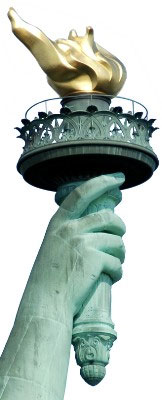
LibertyHand

Wash Your Hands, Please.

Self-Evident

“We hold these truths to be self-evident…”

Seven of the most famous words in American history, from The Declaration of Independence, written mostly by Thomas Jefferson in 1776. The original wording of “We hold these truths to be sacred and undeniable” was edited by Benjamin Franklin to rephrase it as “We hold these truths to be self-evident”.

What is the meaning of self-evident? I don’t have to ask Ben or Tom. Self-Evident is knowing for yourself what is true. Self-evident is using your own mind and reasoning. Self-evident is making your own evidence.

Prove to yourself what is right for you. The signers of the Declaration of Independence declared that what was right for their own selves. Life. Liberty. The pursuit of Happiness.

If you like those words, please keep living them. But if you don’t like those words, find some other words and keep living those. The French prefer Liberty, Equality, and Fraternity. Brazil promotes Order and Progress. India knows that Truth alone Triumphs.

America is not about preaching one way over the other, America is about accepting differing ideas and making sure that every individual is able to live freely. There are no borders to ideas. There are no walls that can keep humanity from living its chosen destiny. America is just as much an idea, a way of life, a perspective on the world, as it is a physical place.

What truths do you hold to be self-evident?

For me, I’ll stick with Life, Liberty, and Happiness.

-The Happy President, January 22, 2019

Freedom of Speech

“Our lives begin to end the day we become silent about things that matter.” Martin Luther King, Jr.

The ability to communicate with each other is the most valuable thing we have as a society – it is how we learn, grow, work together, build things, play games, and connect to something bigger than ourselves. Communicating is how we know what can keep us alive, so we don’t have to relive the same lessons over and over again. The ability to record ourselves is how humanity saves itself and the Earth. Communication is how we know we are not alone.

“What Hath God Wrought?” was the first message instantly communicated over long distance, which in 1844, was the 40 miles between Washington, D.C. and Baltimore, Maryland.  It sounded more like “dot dash dash, dot dot dot dot, dot dash, dash…” because it was sent on a telegram wire via Morse Code, but it made sense to the telegraph operator at the time.

The first human voice recorded was a Frenchwoman singing the folk song “Au Claire de la Lune” in 1860, but it wasn’t until Thomas Edison’s phonograph in 1877 that the world was able to record and playback sound regularly.

The first radio broadcast happened around 1900 to share weather reports, but radio wasn’t a regular communicating device to the masses for another 20 years, and then there was television, then the internet, and now we have cell phone apps.

The United States President has always had to communicate with the American public. George Washington toured the country on horseback and published in newspapers. Rutherford B. Hayes installed telephones to the White House. Franklin Delano Roosevelt embraced radio with his weekly Fireside Chats. John F. Kennedy looked good on camera. Bill Clinton established the first website for the White House. And of course, there’s today’s Presidential Twitter account.

With technology giving humanity the ability to record and share freely, why haven’t I been able to openly give and exchange my thoughts? I am a modern woman. I have a phone. I have a Twitter account. I have all the things necessary to become President, except the ability to communicate. To talk. To speak my mind. Share my opinion. Admit that maybe I am scared by what’s going on and I’m more scared of what will happen if things keep going the way they are.

So no more silence.

(a breath).

Now what do I speak? Sometimes it is easier to speak using someone else’s words first, so here are some quotes.

“Everyone has the right to freedom of opinion and expression; this right includes freedom to hold opinions without interference and to seek, receive and impart information and ideas through any media and regardless of frontiers.”

That is from Article 19 of the Universal Declaration of Human Rights adopted in 1949. Way before Twitter. Before YouTube. Before the internet, and blu-rays, and dvds, and VHS tapes. Before CDs and cassette tapes and 8 Tracks.

I really like it. So here it is again.

“Everyone has the right to freedom of opinion and expression; this right includes freedom to hold opinions without interference and to seek, receive and impart information and ideas through any media and regardless of frontiers.”

Blogs. Podcasts. A true expression of the freedom of speech.

It’s the First Amendment for a reason. These rights are given to the people by the people because it is so important for an individual to be able to freely express themselves, no matter what popular opinion dictates.

“If liberty means anything at all, it means the right to tell people what they do not want to hear.” George Orwell.

I’m someone who never wants to upset anyone. I want the whole world to be happy and fulfilled and merrily singing along to whatever tune they wish to march along with. Having an opinion seems to bring immediate insults, backlash, questioning. It’s like stirring up the muck at the bottom of the lake. It was a clean lake and now it’s dirty because of what you are stirring up. Of course I want a clean lake. But it’s not actually clean if the surface is the only thing that looks clean, and there’s all this muck at the bottom just settled. The opinion’s job is to stir up the muck so it can be cleaned out. Let’s talk, let’s figure it out. Let’s face the fact that no one really knows what we are doing and so let’s all just hold hands and make it work as we go along. Let’s really clean the lake. I mean that both figuratively and literally. Water is the most important resource on Earth.

Freedom of Speech, and of expression, is the most important resource to the individual human.

So now what?

Start expressing yourself. Even just as a blog that no one will read. Write to yourself, learn your own opinions. Make up your mind about things. Figure out for yourself what works for you and the expressions you prefer to bring to the world.

You are special, because no one else in all of existence has the exact same experience as you. The world needs your lessons to be shared. Your opinions are yours for a reason. You are safe, because you live in a world that knows how important expression is to the human soul.

Thank you for reading, and thank you to the people and institutions who promote and protect the Freedom of Speech.

-The Happy President, January 21, 2019